Choosing Your Algarve: A Buyer’s Guide to the Western Coast, Golden Triangle & Eastern Algarve
Published May 2026 | Prices and market data current as of Q1 2026
-----
The Algarve stretches for around 150 kilometres along Portugal’s southern coast, and no two parts of it feel quite the same. Buyers who research the region as a single entity often arrive for viewings and discover that the lifestyle they imagined in Quinta do Lago bears little resemblance to life in Lagos — and that neither has much in common with Tavira. Getting this choice right from the outset is arguably the most important decision in the buying process: far more consequential than negotiating a few thousand euros off the asking price.
This guide breaks the Algarve into its three principal buyer markets — the Western Algarve, the Golden Triangle, and the Eastern Algarve — and gives you the information to match your objectives to the right geography.
-----
1. The Western Algarve
Key towns: Lagos, Portimão, Carvoeiro, Sagres, Vila do Bispo, Aljezur
Price range: approximately €4,000–€6,500 per m² in prime coastal positions; inland from €2,200 per m²
Who buys here: Digital nomads, younger lifestyle buyers, surfers, nature lovers, independent-minded expats, and investors seeking a combination of personal use and rental income.
*The Character of the West
The Western Algarve is defined above all by its coastline. This is the landscape of dramatic cliffs, hidden cove beaches, Atlantic swells, and a raw natural beauty that the more developed central coast largely traded away in the 1980s and 1990s. The beaches here — Praia da Marinha, Praia do Camilo, Meia Praia, Arrifana — are among the most photographed in Europe, and for good reason.
“Lagos” is the western Algarve’s beating heart: a town of real substance with a functioning historic centre, cobbled streets, good restaurants, a marina, nightlife, and a year-round international community. It is not a resort in the traditional sense — it is a town that happens to have extraordinary beaches, which is precisely why it draws a different kind of buyer. In recent years, Lagos has become a magnet for digital nomads, young professional families, and Americans in particular, whose share of luxury property enquiries in the region has grown to around 37% of the international buyer pool. Foreign buyers now account for over 80% of transactions in Lagos in the premium and new-build segments.
“Portimão” offers a slightly more urban experience — larger, busier, and with a strong permanent population — while Carvoeiro delivers a clifftop village atmosphere that appeals strongly to second-home buyers from northern Europe who want character and scenery without the noise of the larger towns. Further west, Sagres and Vila do Bispo represent the Algarve’s most undeveloped frontier: small, unhurried, beloved by surfers and those who want the edge of Europe rather than the resort version of it. Aljezur, just across the boundary into the Costa Vicentina Natural Park, attracts a growing eco-conscious buyer profile.
**The Market in 2026
The western Algarve has been among the strongest performers in the region over the past three years. Lagos recorded approximately 9.7% price growth in 2024 and has maintained momentum into 2026, with per-square-metre prices on prime coastal properties now reaching €5,000–€6,500. Analysts are forecasting Lagos as one of the standout performers through the rest of 2026, driven by continued American buyer demand, constrained supply in the historic centre, and the town’s appeal to the remote working demographic.
Properties here range considerably: older apartments in the historic centre start from around €300,000, while new-build villas with sea views and pools in premium positions above the cliffs reach €1.5 million and above. The market for well-finished, architect-designed homes in the €700,000–€1.5 million bracket has been particularly active, with turnkey properties in sought-after streets selling in around 45 days.
Short-term rental performance in the western Algarve is strong. Well-managed properties in Lagos achieve peak summer occupancy rates of 85–90% and generate gross yields of 5–7%. Critically, Lagos and Portimão also have a growing year-round population of long-stay residents and digital nomads, which helps sustain occupancy in the shoulder and winter months — a significant advantage over purely seasonal markets.
***What to Watch
The western Algarve’s relative authenticity is its greatest asset and its principal vulnerability. As prices rise, the risk of over-tourism and developer pressure increases. Buyers drawn by the town’s independent character should choose carefully — the gap in quality between the best and most mediocre properties in the region is wide. AL (short-term rental) licence availability has also tightened in the most popular areas; always confirm a property’s licensing status before purchase.
Infrastructure is improving but not uniformly: the main EN125 corridor can be slow in summer, and the westernmost areas (Sagres, Aljezur) require comfort with car dependency. Healthcare facilities are centred on Portimão and Lagos; the nearest major hospital is in Faro, around 70 kilometres east.
“Best suited to”: Buyers who want walkable town living with beach access, a genuine year-round community, a mix of lifestyle and rental income, and a property market with strong medium-term capital growth prospects.
-----
2. The Golden Triangle
Key areas: Quinta do Lago, Vale do Lobo, Vilamoura, Almancil
Price range: €7,400–€11,200+ per m² in prime resort positions; Almancil village from €3,500 per m²
Who buys here: High-net-worth families, discretionary lifestyle investors, golf and tennis enthusiasts, those seeking resort infrastructure and privacy in one package, and buyers for whom capital preservation is as important as yield.
*The Character of the Triangle
The Golden Triangle occupies a privileged corridor of the central Algarve between Faro Airport (around 20 minutes away) and some of the region’s finest beaches. It is defined not by any single town but by a cluster of managed resort estates — each with its own character — set within the broader municipality of Loulé, the Algarve’s wealthiest and most internationally connected local authority.
“Quinta do Lago” is the apex of Portuguese luxury real estate. As of early 2026, it holds the highest average price per square metre in the entire country — above prime Lisbon. At approximately €11,170 per m², with development tightly controlled by the natural constraints of the Ria Formosa Natural Park, the estate offers 550 hectares of low-density villas and leisure facilities, five championship golf courses, private lake access, and a residential atmosphere that feels entirely removed from the tourist Algarve. Entry-level properties begin above €2 million; frontline golf and lake villas regularly exceed €10 million. The estate reported a 34.6% year-on-year price increase in 2025 — a figure that reflects both genuine structural scarcity and continued strong demand from internationally mobile buyers.
“Vale do Lobo” occupies the coast immediately west of Quinta do Lago, with clifftop villas looking out directly over the Atlantic and a central praça of restaurants, tennis academies, a medical clinic, and beach clubs. Averaging approximately €7,400–€7,700 per m² in early 2026, it offers resort-level infrastructure at a slight discount to its immediate neighbour, and attracts families who want the convenience of having everything on foot in summer. The beach position is, if anything, more visually dramatic than Quinta do Lago’s lake-and-golf orientation.
“Vilamoura” is the largest and most diverse of the three. Built around one of Europe’s most celebrated marinas, it encompasses a spectrum from marina-front apartments at €4,500–€6,000 per m² to large villas adjacent to championship golf courses at significantly higher values. Vilamoura is more open and varied than the gated estates to its west — it has a town centre, a casino, multiple hotel brands, and a broader price range. For buyers seeking lifestyle flexibility combined with rental income potential, Vilamoura consistently offers the most attractive combination: gross rental yields of 5–8% in well-managed properties, a high-occupancy tourist season, and a large, international existing community.
“Almancil”, the inland town that services the Golden Triangle, sits at a significantly lower price point and provides a more authentic daily-life experience — local supermarkets, pharmacies, schools, restaurants — while remaining within minutes of Quinta do Lago and Vale do Lobo.
**The Market in 2026
The Golden Triangle presented a tale of two markets in 2025. At the ultra-prime end — Quinta do Lago and Vale do Lobo — luxury properties saw sales volumes rise 18% year-on-year and prices increase approximately 10%. At the broader mid-market level (€300,000–€800,000), the market was more selective: buyers became more discerning, days-on-market lengthened for overpriced stock, and negotiation margins opened up.
Going into 2026, the premium end remains the strongest: turnkey villas near golf courses and the lagoon in Quinta do Lago continue to sell at or above asking price to a well-capitalised international buyer base. US, UK, and German buyers dominate. The marina-facing Vilamoura apartment market has recovered well following the 2023–24 interest rate squeeze, and new development is concentrated around the Vilamoura outskirts and the Almancil corridor.
One defining characteristic of Golden Triangle ownership is the prevalence of corporate and offshore ownership structures. Many of the most prestigious addresses — particularly in Quinta do Lago and Vale do Lobo — are held through company structures for estate planning and inheritance flexibility. Any buyer considering a property here should take early advice on ownership structure.
***What to Watch
The Golden Triangle’s greatest strength — its managed, resort-like environment — also means it has a more homogeneous buyer and resident profile, a degree of seasonal emptiness in winter, and limited sense of integration with Portuguese culture. For buyers whose lifestyle vision includes authentic local community, daily markets, and language immersion, the Triangle may feel isolating outside the summer months.
The AIMI surcharge — Portugal’s wealth-based property tax — bites significantly here given asset values. A villa held personally with a taxable value above €600,000 (which applies to most properties in this market) attracts AIMI at 0.7–1.5%, making ownership structure a material financial consideration rather than a minor tax planning footnote.
New supply in the Triangle is genuinely restricted — particularly in Quinta do Lago, where the Ria Formosa’s protected status limits development. This structural scarcity underpins long-term values in a way that more open markets cannot replicate.
“Best suited to”: Buyers prioritising privacy, prestige, and golf or beach-club resort infrastructure; those with budgets typically above €1.5 million; buyers for whom capital preservation and European positioning matter as much as rental yield; and families who want security, international schools nearby, and a proven community.
-----
3. The Eastern Algarve
Key towns: Tavira, Olhão, Faro, Castro Marim, Alcoutim, Vila Real de Santo António
Price range: approximately €3,000–€5,500 per m² in Tavira and Olhão; inland from €1,000–€2,000 per m²; Faro from €2,500 per m²
Who buys here: Retirees seeking year-round lifestyle, culturally motivated buyers, investors seeking relative value and steady appreciation, and buyers priced out of the western and central markets.
*The Character of the East
The Eastern Algarve is the Algarve that exists before tourism arrived in force — and, largely, still does. Here, the landscape opens into the vast shallow lagoon of the Ria Formosa Natural Park, a 60-kilometre arc of wetlands, salt flats, and barrier islands that is one of the seven natural wonders of Portugal. The towns are older, more Portuguese, less developed. The beaches — on the offshore islands of Tavira and Armona, reached by ferry or water taxi — are broad, undeveloped, and frequently listed among the finest in Europe.
“Tavira” is the east’s most distinguished town, and arguably the most beautiful in the entire Algarve. Bisected by the Gilão River, crossed by a Roman bridge, and watched over by a Moorish castle, Tavira has a historic depth that the resort towns to its west cannot replicate. Its 37 churches (earning it the nickname “the city of a thousand bells”) line streets of azulejo-faced houses and wrought-iron balconies. It feels like a real town, because it is — with a market, a hospital, schools, independent restaurants, and a community of Portuguese residents alongside a growing international population. Foreign buyers account for over 90% of transactions in the premium segment, drawn by a combination of authenticity, climate, proximity to Faro Airport (33 km), and prices that still represent excellent value relative to what the same budget would buy further west.
“Olhão” offers a rawer, more working-class energy: a fishing port town with an excellent covered market, a vibrant café culture, and a growing creative and expat community that has begun to reshape its marina district. It has been one of the Algarve’s most active gentrification stories of the past three years, with price appreciation of 25–40% in certain neighbourhoods as buyers priced out of Lagos and the west shifted their attention eastward. Specialty coffee shops, co-working spaces, and boutique conversions in former fishermen’s warehouses are now common sights.
“Faro”, the regional capital, is the Algarve’s administrative and transport hub — home to the international airport, the university, a general hospital, major shopping, and a genuinely urban lifestyle. Its old town, enclosed within medieval city walls and overlooking the lagoon, is atmospheric and undervalued. As infrastructure improves along the eastern rail corridor, Faro is attracting attention from buyers who want city amenities without city prices.
Further east, “Castro Marim” and “Vila Real de Santo António” — at the Spanish border — remain largely undiscovered by international buyers, offering dramatic castle views, the Guadiana River estuary, and some of the most accessible entry prices anywhere on the coast.
**The Market in 2026
The eastern Algarve is the market story of the moment. Tavira recorded 10.4% year-on-year price growth — the strongest of any named location across the region — as demand from international buyers accelerated. Olhão and the Faro corridor are experiencing similar momentum. From a pricing base of €3,000–€5,000 per m² in Tavira and €2,500–€4,000 per m² in Olhão, the east still offers meaningful value relative to the west and the Golden Triangle, but the gap is narrowing.
The rail modernisation project along the eastern Faro–Vila Real de Santo António corridor, currently being phased through 2026 and 2027 under EU Recovery and Resilience funding, is adding a structural tailwind to property values in towns along the line. Infrastructure-linked price uplift of 10–20% at completion is a pattern seen elsewhere in Europe and is beginning to be priced in to forward-looking investment decisions.
The eastern Algarve is not — yet — a strong short-term rental market in the sense that the central and western Algarve are. Peak season occupancy can reach 80–85% in Tavira and Olhão, but the shoulder and winter seasons are quieter, and gross rental yields of 4–6% are more typical than the 6–8% available in prime western locations. What the east does offer is a buyer profile oriented toward longer stays and permanent relocation — digital nomads, retirees, and year-round residents — which generates more stable occupancy patterns than pure tourist-season demand.
Renovation opportunities are abundant. The east has a higher concentration of older Portuguese residential stock — traditional houses, fishermen’s cottages, historic town houses — that can be acquired at lower prices and transformed into distinctive homes or character-led holiday rentals that outperform generic resort product. For buyers with vision and patience, the east rewards creativity.
***What to Watch
Healthcare is the east’s most significant practical limitation for permanent residents. While Tavira has a health centre and a small hospital, complex medical care requires a trip to Faro. This is rarely a concern for younger buyers but is a material consideration for retirees, and should inform the choice between Tavira and Olhão (both of which are within manageable distance of Faro’s main hospital) and the more remote inland towns.
The short-term rental market is competitive but narrower than the west. AL licence restrictions have also tightened in Tavira’s historic centre. Buyers primarily motivated by rental yield rather than lifestyle should weigh the eastern Algarve against western options carefully; the authenticity premium that attracts residents does not always translate directly into holiday booking rates.
Resale liquidity is thinner in the east than in the Golden Triangle or Lagos. Properties at the top of their local market can take longer to sell, and exit timing matters more if investment flexibility is a priority.
“Best suited to”: Buyers seeking year-round lifestyle in a genuine Portuguese community; retirees and long-stay expats who value authenticity over resort infrastructure; investors with a medium-to-long time horizon looking for relative value and above-average appreciation potential; and those drawn to renovation projects, historic buildings, and character-led properties.
-----
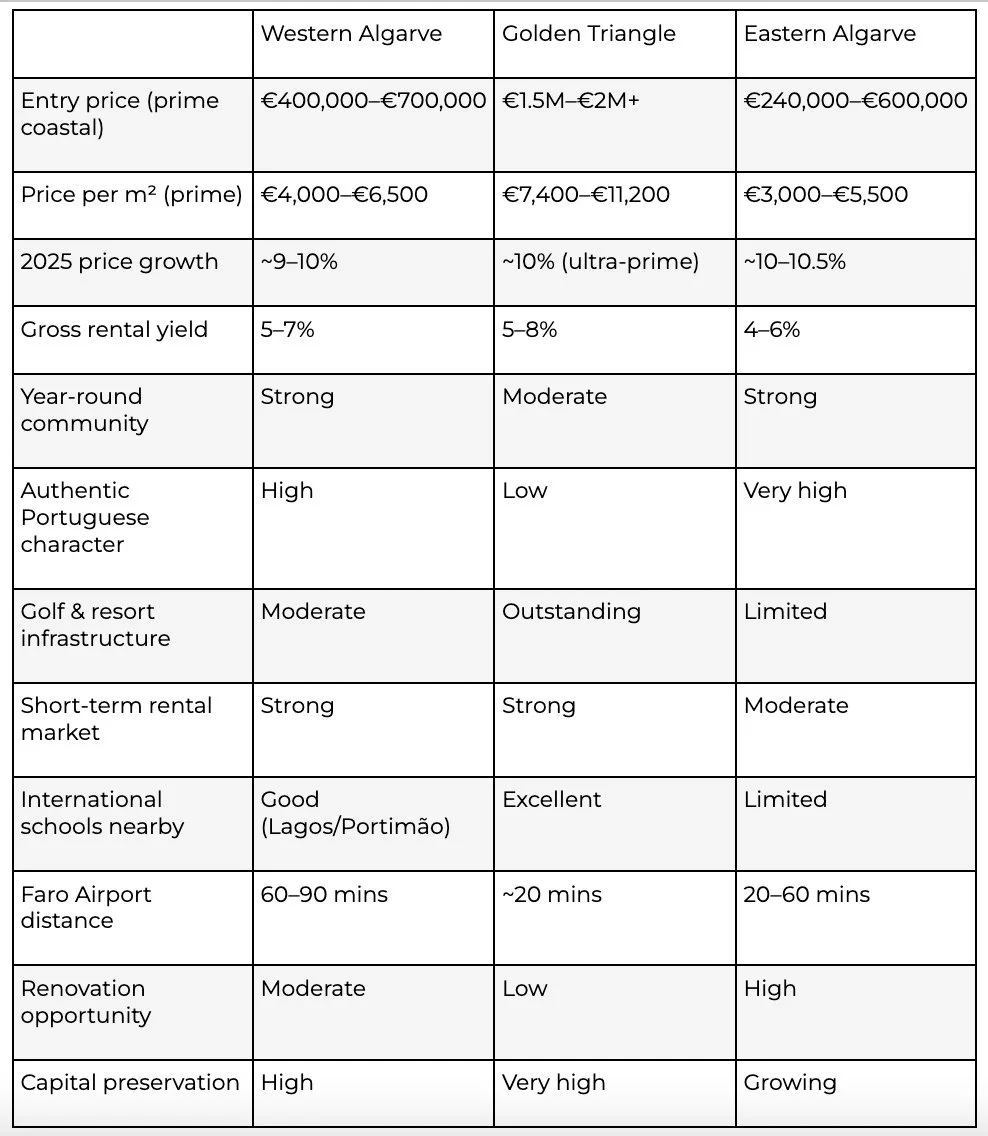
## Side-by-Side Comparison
-----
## The Question That Matters Most
After working with buyers across all three zones, the question that reliably sharpens the decision is not “which area has the best investment fundamentals?” but rather: How do you want to feel on a Tuesday in November?
If the answer is coffee in a café where the owner knows your name, a walk to a market, and a view of a river from a town that has been inhabited for three thousand years — the east is your place. If it is a pre-dawn tee time on one of Europe’s finest fairways, followed by a swim in a private lake with your family — you want the Golden Triangle. And if it is standing on a cliff watching the Atlantic, a cold coffee in one hand and a MacBook in the other, in a town full of people who made the same choice — the west is calling.
As your buyer’s agent, our role is to make sure the property you choose serves the life you are actually going to live — not an abstract version of it. We work across all three zones and can give you ground-level guidance on specific streets, development pipelines, rental markets, and the off-market opportunities that never reach the property portals.
-----
This article is for informational purposes only. Market data reflects Q1 2026 pricing and should be verified at time of purchase. Always engage a qualified lawyer and independent financial advisor before proceeding with any property acquisition.